Improving the gas barrier property of cellulose nanofibril (CNF) film at higher relative humidity
Cellulose Nanofibrils are well known for their oxygen barrier property at lower relative humidity, which makes the highly potential for packaging and flexible electronic applications. However, their oxygen barrier property exponentially decreases at higher relative humidity (> 65%). In this project, we are trying to figure out how we can improve the oxygen barrier property at higher relative humidity. As first step, we prepared CNF films by four drying techniques and found that hot press drying is the most convenient drying technique to reduce oxygen and water vapor permeability. We also found a simple thermal compression technique on dried films that can reduce the oxygen permeability by 43% and water vapor permeability by 22%.
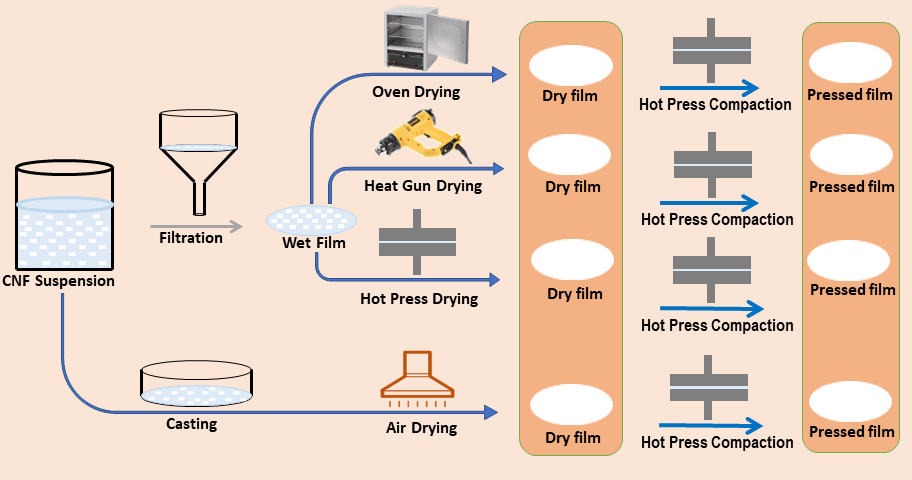
The other issue with CNF is their manufacturing process is energy intensive. There is a very recent type of CNF which is produced from old corrugated container (OCC) which consumes 44% less energy compared to bleached kraft pulp produced CNF. Currently, I am trying to bring the same oxygen and water vapor barrier property of OCC produced CNF film. The OCC produced CNF suspension is not colloidally stable and they do not form as strong hydrogen bond as the other one because of the presence of lignin. We are currently working to overcome these challenges.
Oil extraction, biodiesel production and characterization from locally available non-edible seeds
I started working on this project while I was a junior with Dr. Mohammad Ismail at the Clean and Affordable Energy Lab, University of Dhaka. As Bangladesh has a lot of biomass and most of them was underutilized, this project was intended to evaluate the fuel properties and the biodiesel production potential of three non-edible seeds (Shorea robusta, Jatropha curcas, Aphanamixis polystachya) and waste cooking oil.
The oil extraction method involved three different techniques- soxhlet extraction, ultrasonication and mechanical extraction. The extracted oil was characterized by physico-chemical parameters and the fatty acid composition was determined by Gas Chromatography coupled with Flame Ionization Detector. The biodiesel production was carried out with methanol using NaOH as catalyst. Fuel and thermal properties of the produced biodiesels were evaluated using physiochemical parameters and TGA.

This project was jointly funded by the Ministry of Science and Technology, Bangladesh, Bangladesh Bureau of Educational Information and Statistics and University of Dhaka.
Existence of Hexacoordinated Silicon- An Answer from Density Functional Theory
This was my first formal research project that I started at the end of my university second year at The Red-Green Research Center. I was trained on basic computational chemistry tools and drug design. The idea was to computationally show that silicon can show hexacoordination. Malischewski and Seppelt from Free University of Berlin determined the crystal structure of pentagonal pyramidal Hexamethyldewarbenzene dication, which shows a carbon atom making bonds with six other carbon atoms, i.e. the valency of one carbon is six.
I, along with my supervisor Dr. Mohammad A Halim, computationally proved a new compound that contains Hexacoordinated silicon. The compound was optimized with Density Functional Theory and Moller Plesset Theory. Bond lengths, Molecular Orbitals, Charge Distribution and other parameters were analyzed and compared with hexacoordinated carbon compound. A mechanistic study of the reaction pathway was also performed to predict the feasibility of the reaction.
This work won the Best Oral Presenter award in the annual conference of Bangladesh Chemical Society.

 Md. Ikramul Hasan